
The Legacy of Charles Dickens: How His Stories Inspired American Holiday Traditions
Charles Dickens, one of the most beloved and influential authors of the 19th century, has left an indelible mark on Christmas celebrations, particularly in the United States. While Dickens’ stories are varied in their subject matter, it is A Christmas Carol, published in 1843, that remains the most influential of his works when it comes to shaping modern holiday traditions. As the story of Ebenezer Scrooge’s transformation from a miserly, cold-hearted man to a generous benefactor resonates deeply with the themes of redemption, compassion, and goodwill, it has inspired countless American traditions, both in how Christmas is celebrated and in how the holiday is depicted in literature, theater, and film. As the holiday season approaches–my favorite time of the year–I like to reflect on how A Christmas Carol was embraced in the United States and the ways in which Dickens’ storytelling shaped American holiday customs, literature, and the collective imagination surrounding Christmas. From its early reception in America to its influence on both holiday decorations and the literary treatment of the season, Dickens’ legacy endures in December traditions that have come to define the American Christmas experience.
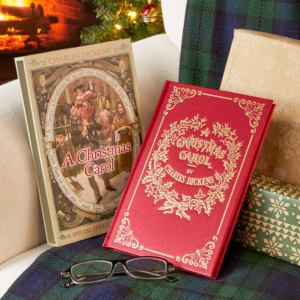
Early American Reception of A Christmas Carol
When A Christmas Carol was first published in 1843, Dickens was already well-known in the United States, having enjoyed considerable popularity since the release of The Pickwick Papers in the 1830s. However, A Christmas Carol was unlike anything Dickens had written before. It was a short novella, deeply moral in its message, and explicitly centered on the Christmas season. It resonated immediately with American readers, not just because of its vivid characters and rich storytelling, but also because of its themes of charity, community, and transformation—ideas that were becoming increasingly central to the American ethos in the 19th century.
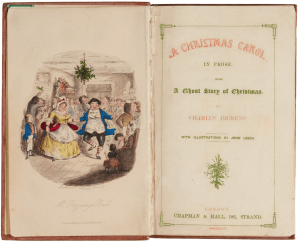
At the time, Christmas in the United States was not yet the major celebration it is today. Looking back, in some ways, we might see it as a relatively minor holiday for much of the 18th and early 19th centuries. Many Americans were influenced by Puritanical traditions, which had banned Christmas celebrations in the colonies. However, by the 1830s, Americans were beginning to look toward Europe, especially England, for a more festive and communal observance of Christmas. Dickens’ A Christmas Carol, with its focus on family, generosity, and social responsibility, helped fuel the revival of Christmas as a time of both personal reflection and public charity.
American readers embraced the novella with enthusiasm, and it became an instant holiday classic. The story was frequently reprinted in newspapers, and it was soon adapted into plays, with performances spreading across the U.S. by the mid-19th century. The novella’s themes of personal transformation and the importance of community service and compassion fit seamlessly with the growing American interest in moral reform movements, such as the abolition of slavery and the rise of the temperance movement. A Christmas Carol became not just a holiday story, but a call to action for American society to embrace the values of kindness and charity, both on a personal and societal level.
Influence on the American Celebration of Christmas
One of the most significant ways in which Dickens’ work influenced Christmas in the U.S. was through its depiction of holiday traditions. A Christmas Carol not only revived the idea of Christmas as a time for family gatherings and gift-giving but also helped shape how people decorated their homes and the kinds of customs they practiced during the holiday season.
Prior to Dickens, Christmas in America was primarily a religious holiday, and many of the festive customs now associated with the holiday—such as the Christmas tree, holiday cards, and large family feasts—had not yet become standard. Dickens’ emphasis on family unity, warmth, and generosity in A Christmas Carol encouraged American readers to embrace the festive elements of the holiday in a more personal, familial way. The Christmas dinner, the joy of giving gifts, and the importance of visiting friends and family all became central to the American holiday experience.
Dickens’ portrayal of Christmas Eve as a magical, transformative night, when Scrooge is visited by the spirits of Christmas Past, Present, and Yet to Come, helped solidify the idea of the season as a time for introspection and spiritual renewal. This resonated with Americans who were drawn to both the commercial and religious aspects of the holiday. The image of the Christmas ghostly visitations, the lighted candles, and the glow of warmth in the home became part of the collective American imagination surrounding the holiday.
In particular, Dickens’ A Christmas Carol helped make the image of the Christmas tree more widespread in America. Although the Christmas tree tradition was not new—roots of the custom can be traced to Germany and other European countries—it was Dickens’ works and his love of the Christmas season that popularized the tree in the English-speaking world. Dickens himself was a fan of the tradition and wrote about it with affection in several of his works. The idea of decorating a tree as part of a joyful Christmas celebration, as seen in A Christmas Carol and other Dickens stories, was embraced in America by the mid-19th century.
Finally, the story’s central moral lesson—that wealth and success should be used to benefit others—aligned perfectly with the increasing American focus on charity during the holidays. By the time of the Civil War, the American Christmas had evolved from a quiet religious observance into a more festive, community-oriented event, marked by charitable acts, family gatherings, and elaborate celebrations. Many of these practices were directly influenced by the lessons of A Christmas Carol, which became a touchstone for the nation’s growing sense of Christmas as a time for generosity, self-improvement, and social responsibility.
The Emergence of Christmas Literature in America
Dickens’ impact on American literature and the holiday season is perhaps best illustrated by how his own style and thematic concerns shaped the development of Christmas stories in the United States. The idea of a redemptive, transformative Christmas was carried forward in a number of American literary works that echoed the spirit of A Christmas Carol. In fact, the very idea of a “Christmas story”—a narrative centered around moral awakening, personal change, and family unity—owes much to Dickens’ novella.
The work of American authors like Louisa May Alcott and Henry James shows the extent to which Dickens’ A Christmas Carol shaped how the Christmas season was treated in American fiction. Alcott, in her beloved novel Little Women (1868), presents a family dynamic that mirrors some of the central values of Dickens’ work: sacrifice, charity, and the joy of giving. The March sisters in Little Women echo the generosity and moral resolve of Scrooge’s transformation, and Alcott’s Christmas chapters are filled with themes of selflessness, just as Dickens’ novella emphasizes the importance of looking beyond oneself for the greater good.
Many authors began to craft their own Christmas-themed stories, from short stories to novels, that focused on the themes of family togetherness, community service, and self-reflection. Works like The Gift of the Magi by O. Henry (1905) and Truman Capote’s A Christmas Memory (1956) all carry forward the Dickensian notion that Christmas is a time for personal growth, generosity, and a renewed sense of connection to others.
A Christmas Carol in American Theater and Film
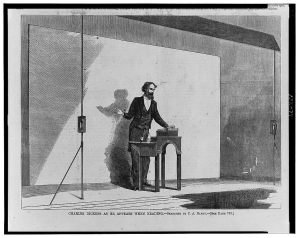
The tradition of adapting A Christmas Carol into various forms of popular entertainment is perhaps the most visible legacy of Dickens’ work in the United States. The first American stage adaptation of A Christmas Carol premiered in 1849, just six years after the novella was published, and the play’s success demonstrated the American public’s appetite for Christmas tales with a moral edge. Over the years, A Christmas Carol has been performed in theaters across the country, becoming a seasonal tradition in cities from New York to Chicago.
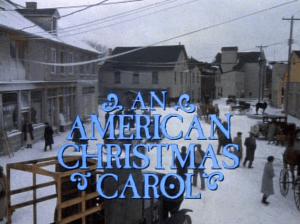
Perhaps most notably, the 1938 radio broadcast starring Orson Welles and the 1951 film adaptation featuring Alastair Sim helped cement the story’s cultural significance in the U.S. The Scrooge character, with his iconic transformation from miser to philanthropist, became a symbol of the holiday spirit in both American theater and film. Subsequent adaptations, including the 1984 television version starring George C. Scott and the 2009 animated film featuring Jim Carrey, continued to reinforce the enduring influence of Dickens’ themes.


Through these adaptations, A Christmas Carol not only became a holiday tradition in American homes but also helped solidify the modern idea of Christmas as a time of spiritual reflection, family bonding, and charitable giving. The story’s central moral of redemption and transformation continues to resonate in contemporary adaptations, keeping Dickens’ legacy alive in the American holiday season.
Dickens’ Enduring Christmas Legacy in America
Charles Dickens’ A Christmas Carol has had an enduring influence on Christmas in the United States, shaping both the cultural and literary observance of the holiday. From its early American reception to its ongoing adaptations in theater, literature, and film, the story has helped shape how Americans celebrate Christmas today. Its themes of generosity, redemption, and the importance of community have become cornerstones of American holiday traditions, and its influence can be seen in everything from holiday décor to charitable acts performed during the Christmas season.
As Christmas approaches, it is impossible to ignore the legacy of Charles Dickens, whose work remains central to how we understand, celebrate, and reflect on the spirit of Christmas. Through A Christmas Carol, Dickens helped transform Christmas from a quiet religious observance into a celebration that embraces both the joy of giving and the possibility of personal transformation. As long as people gather to share in the spirit of the season, Dickens’ timeless story will continue to inspire generations to come.


 The Projector
You must be logged in to post a comment.