
Is Google Making Us Shallow? Reflections on Nicholas Carr and the Value of Deep Reading
This past week in class, I revisited Nicholas Carr’s now-famous 2008 essay, Is Google Making Us Stupid?, alongside portions of his follow-up book The Shallows: What the Internet Is Doing to Our Brains. It was not my first time teaching the essay, but each time I return to it with students, I notice how the questions Carr raised nearly two decades ago still resonate—perhaps even more urgently now.
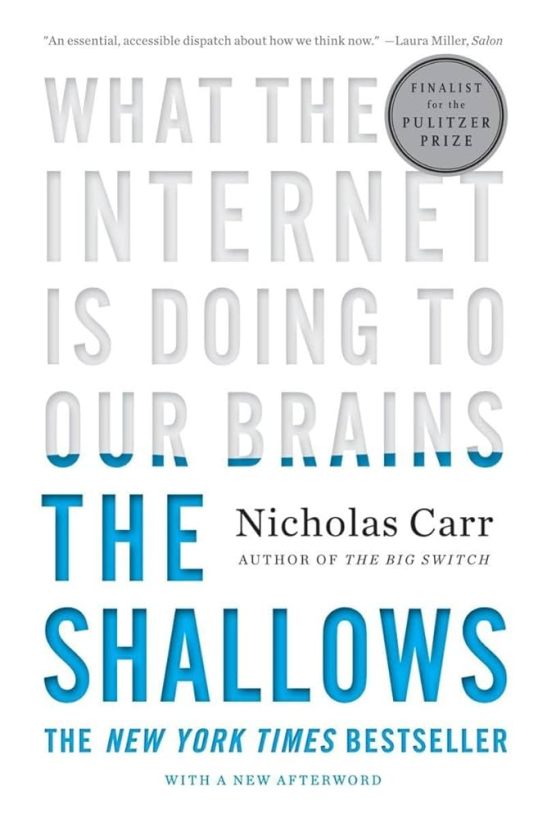
Carr’s central argument in the essay is deceptively simple: the ways we consume information shape the ways we think. He suggests that as the internet—and Google in particular—has trained us to scan, skim, and hop from link to link, it has diminished our capacity for sustained, deep reading. When Carr first published the piece, many readers dismissed his worries as alarmist or technophobic. After all, wasn’t the internet just another tool, like a library card catalog or the printing press? But his follow-up work, The Shallows, grounded those personal observations in cognitive science, showing how the brain’s neuroplasticity adapts to repeated habits. The more we skim, the more our neural pathways are rewired toward distraction.
When I teach Carr’s essay, students often begin with a predictable split. Some nod in agreement, confessing that they, too, find themselves struggling to finish a long article or to read a novel without checking their phones. Others push back, insisting that digital multitasking is a skill in itself, and that the internet’s speed and abundance is a net positive. The discussion usually circles around personal anecdotes: “I used to read all the time when I was younger, but now I just scroll TikTok for hours,” or “I think I’ve learned more from YouTube than I ever did from school.”
But what stands out most is not just the validity of Carr’s argument, but the way it forces us to confront deeper questions about selfhood, attention, and community. If the internet changes how we read and think, then it also changes who we are—our memory, our imagination, and our sense of narrative continuity. Reading extensively and deeply is not merely an academic skill; it is a way of grounding ourselves in identity.
Extensive reading—reading long books, reading widely across genres and disciplines, returning to texts with patience and reflection—cultivates habits that resist fragmentation. When we immerse ourselves in a novel or wrestle with a dense essay, we practice more than comprehension. We practice empathy, as we inhabit perspectives different from our own. We practice humility, as we acknowledge that some ideas take time and struggle to understand. And we practice endurance, learning that attention is not an innate gift but a discipline that must be cultivated.
This has real consequences beyond the classroom. In a culture where information is constant, and distraction is the default, carving out space for deep reading becomes an act of resistance. It reminds us that our identities are not reducible to algorithmic preferences or quick takes. It insists that we are beings capable of reflection, capable of holding complexity without rushing to the next notification.
Communities, too, benefit from this kind of deep engagement. When a society values introspection, it creates citizens who can listen more carefully, deliberate more patiently, and imagine futures more creatively. Shallow reading encourages instant reaction and division; deep reading encourages dialogue and depth. I am struck, when teaching Carr, by how often students leave the conversation not just with a critique of technology, but with a renewed desire to read more, to turn off devices for an hour, to re-learn how to be alone with a book and their own thoughts.
Carr never argued for abandoning technology; rather, he urged us to be conscious of how it shapes us. That consciousness remains essential today. The internet is not going away, nor should it. But neither should we surrender the practices that form us as whole, attentive, empathetic selves.
So perhaps the real question is not simply, Is Google making us stupid? but rather, What kind of selves are we becoming through our habits of attention? The call, then, is to reclaim deep reading as a cornerstone of both personal identity and communal life. To sit with a text without interruption. To resist the lure of the quick skim. To let words reshape us slowly.
At the end of class, I sometimes remind students that reading deeply is not about nostalgia for a pre-digital world. It is about cultivating the kind of minds and communities we want for the future—ones that can withstand distraction, embrace complexity, and find meaning beyond the next click.


 The Projector
You must be logged in to post a comment.