
General Casimir Pulaski: A Polish Hero of the American Revolution
Every year, the United States recognizes General Casimir Pulaski—Polish-born hero of the American Revolution—on October 11, commemorating his death from wounds received at the Siege of Savannah in 1779. Known as the “Father of the American Cavalry,” Pulaski’s courage, military expertise, and devotion to liberty left a permanent mark on America’s fight for independence.
For Polish Americans, and for all who honor the ideals of freedom and sacrifice, General Pulaski Memorial Day is more than a historical remembrance—it is a celebration of transatlantic solidarity, heroism, and enduring legacy.
Early Life in Poland
Casimir Pulaski (Kazimierz Michał Władysław Wiktor Pułaski) was born on March 4, 1745, into a noble family in Warsaw. His father, Józef Pulaski, was a respected member of the Polish nobility and an active political leader, which meant that young Casimir grew up immersed in the complex political debates of 18th-century Poland.
Pulaski’s formative years coincided with one of the most turbulent periods in Polish history. The once-mighty Polish–Lithuanian Commonwealth was in decline, increasingly vulnerable to interference from neighboring empires—Russia, Prussia, and Austria. Determined to defend Polish sovereignty, Pulaski joined the Bar Confederation (1768–1772), a movement of nobles resisting Russian domination and the erosion of Poland’s independence.
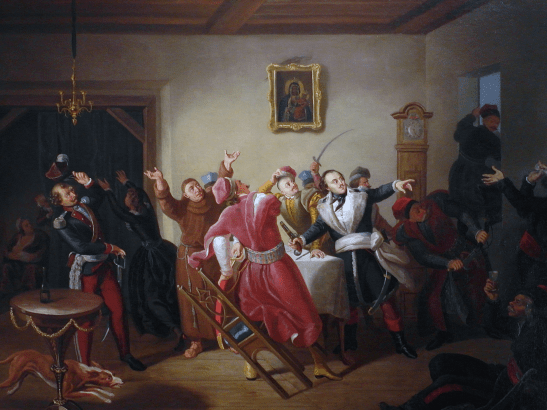
Korneli Szlegel, Pułaski w Barze, 1850. Oil on canvas. Muzeum im. Pułaskiego w Warce.
During this period, Pulaski gained valuable battlefield experience. He fought in numerous skirmishes against Russian forces, learning the importance of mobility, cavalry strikes, and guerrilla-style tactics. These lessons would later serve him well in the very different terrain of North America. However, when the Confederation collapsed, Pulaski was forced into exile, his reputation damaged by Russian accusations that he had plotted against foreign monarchs.
Exile took Pulaski across Europe, where his reputation as a soldier without a country made him a natural ally for revolutionaries elsewhere. It was here that his path crossed with Benjamin Franklin, then in Paris seeking support for the American Revolution. Franklin immediately recognized Pulaski’s military brilliance and sense of mission, and he provided Pulaski with a letter of introduction to General George Washington. This letter would change the course of Pulaski’s life.
Arrival in America
Pulaski arrived in the United States in 1777, at a critical juncture in the Revolutionary War. The Continental Army was struggling. Despite victories at Trenton and Princeton, Washington’s forces faced ongoing shortages of supplies, training, and manpower. The British remained a formidable opponent, their armies better equipped and supported by the world’s strongest navy.
Within weeks of his arrival, Pulaski had the opportunity to prove himself. On September 11, 1777, at the Battle of Brandywine, British forces attempted a surprise flanking maneuver against Washington’s army. Recognizing the danger, Pulaski urged Washington to redeploy his troops. Then, leading a swift cavalry countercharge, Pulaski helped to buy precious time for the American forces to retreat in good order.
Although the Americans were defeated at Brandywine, Pulaski’s actions prevented a complete rout of Washington’s army. Washington himself acknowledged the Polish soldier’s bravery and quick thinking. Within a month, Pulaski was officially commissioned as a Brigadier General in the Continental Army—a rare honor for a foreign officer—and was placed in command of the cavalry.
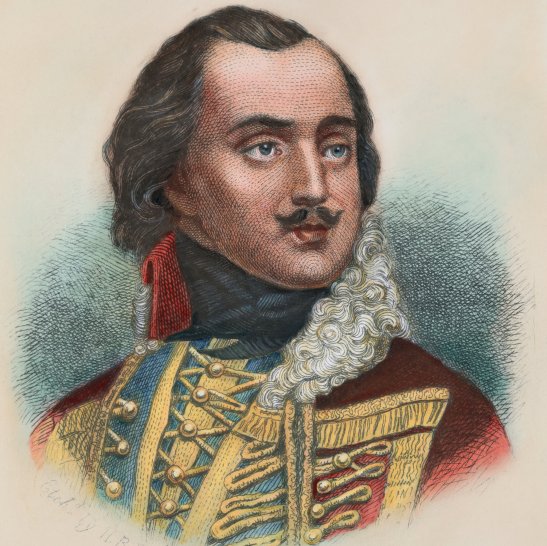
Father of the American Cavalry
Pulaski’s appointment was not merely symbolic. At the time, the American cavalry was disorganized and underperforming. Horses were poorly trained, equipment was inconsistent, and officers lacked experience in leading mounted troops.
Pulaski immediately set about reforming the cavalry, drawing on his experience from Poland. He emphasized discipline and rigorous drills, insisting that cavalrymen be prepared to maneuver at high speed, maintain formation, and adapt quickly to battlefield conditions and trained his men to fight not only with sabers but also with pistols, carbines, and lances, giving them versatility. Pulaski believed cavalry’s greatest strength lay in rapid strikes, so he taught his troops to use sudden charges to disrupt enemy lines, to pursue retreating forces, and to serve as the army’s “eyes and ears” by scouting enemy movements.
Where the American cavalry had been a patchwork, Pulaski introduced more uniform standards for saddles, weapons, and training methods. This consistency made units more effective on the battlefield. Pulaski’s reforms were not always universally welcomed. His European style of leadership, with strict discipline and uncompromising standards, sometimes clashed with the more egalitarian culture of the Continental Army. Nevertheless, his reforms laid the groundwork for what became a lasting American cavalry tradition.
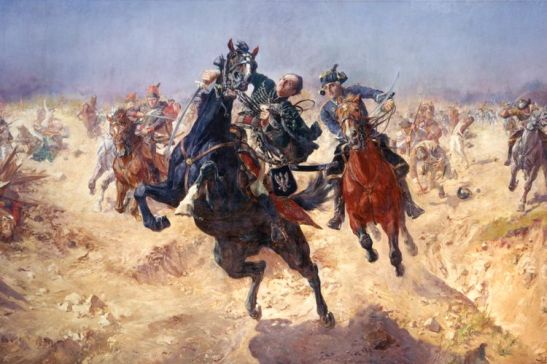
The Pulaski Legion
In 1778, Pulaski persuaded Congress to let him form an independent unit, known as the Pulaski Legion. This unit was modeled after the Polish light cavalry (uhlan tradition), and it combined American volunteers with European émigrés. It was effectively a mini-army, composed of both cavalry and infantry.
The Legion embodied Pulaski’s vision of a mobile, versatile fighting force. It carried out scouting missions, engaged in lightning raids, and harassed British supply lines. Among their key actions:
- The Battle of Egg Harbor (October 1778): The Legion was surprised in a night raid, suffering heavy losses, but the unit’s resilience proved their mettle.
- Raids in New Jersey and Pennsylvania: The Legion excelled at guerrilla-style warfare, disrupting British communications and limiting their mobility.
Pulaski poured his own fortune into the Legion, paying for supplies and equipment out of pocket. This personal investment reflected his deep commitment—not just as a soldier, but as someone who saw America’s struggle for independence as part of a universal fight for liberty.
The Siege of Savannah and Pulaski’s Death
In 1779, Pulaski and his Legion joined French and American forces in the southern theater of the war. Their target was Savannah, Georgia, which had been captured by the British. The Siege of Savannah was one of the bloodiest battles of the Revolution. On October 9, 1779, during a decisive assault, Pulaski led a daring cavalry charge to rally disorganized troops and break the British defenses. In the midst of the charge, he was struck by grapeshot.
Accounts differ on what followed. Some say he was carried aboard a ship and died at sea two days later. Others suggest he was buried near Savannah. Regardless of the details, what is clear is that Casimir Pulaski died on October 11, 1779, at just 34 years old.
His sacrifice made him a martyr of the Revolution. Washington mourned his loss, and French officers compared his courage to that of Europe’s greatest commanders.
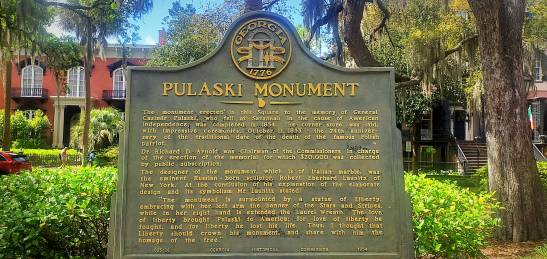
Legacy in the United States
Although his life was short, Pulaski’s impact endured long after the Revolution. His military reforms transformed the Continental cavalry from an undisciplined and disorganized body into a force capable of playing a decisive role in the war. His emphasis on rigorous training, mobility, and discipline gave the American cavalry its identity, and later generations of officers continued to draw on his model. For this reason, he is remembered as the “Father of the American Cavalry,” a title that captures both his innovations and his commitment to excellence.
Pulaski’s sacrifices were also recognized in symbolic ways. Centuries after his death, the United States Congress granted him honorary American citizenship in 2009. This distinction is exceedingly rare—bestowed on only a handful of historical figures such as Winston Churchill and Mother Teresa—and it reflects the extraordinary fact that a foreign-born volunteer, who gave his life in a struggle not originally his own, became an enduring figure in American national memory.
His name and likeness are woven into the cultural and geographic landscape of the United States. Counties, cities, schools, and highways bear his name, and statues stand in Washington, D.C., Chicago, and Savannah as testaments to his sacrifice. These commemorations are not confined to monuments: they are lived traditions as well. The Pulaski Day Parade in New York City, held every October, and the observance of General Pulaski Memorial Day across the nation keep his story alive for new generations of Polish Americans and others who admire his courage.
For the Polish American community especially, Pulaski represents more than a military figure; he is a cultural symbol and a bridge between two nations. His life demonstrates the enduring ties of solidarity between Poland and the United States, reminding us that the fight for liberty has always been international in scope. Pulaski’s story is not just about one man’s bravery—it is also about the larger ideals of sacrifice, freedom, and shared struggle that continue to shape the American identity.
General Pulaski Memorial Day, observed annually on October 11, ensures that his story is not forgotten. The day honors his sacrifice and celebrates the international cooperation that helped secure American independence.
Pulaski also stands as a cultural touchstone in Polish American communities. October is also Polish American Heritage Month, and Pulaski is often at the center of parades, lectures, and commemorations. His name carries the dual weight of patriotism and cultural pride.
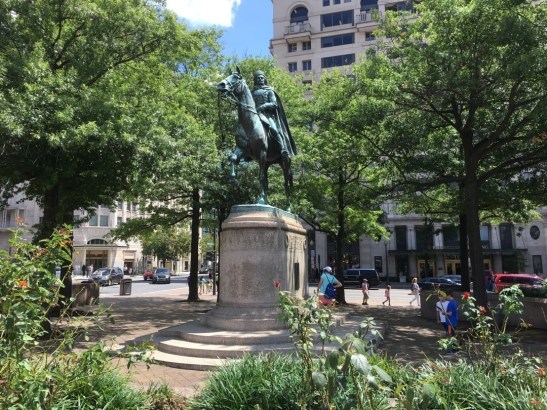
Brigadier General Count Casimir Pulaski Memorial, National Mall, District of Columbia.
Further Reading
- Edward Pinkowski, Pulaski: The Forgotten Hero of the American Revolution.
- Clarence Augustus Manning, Soldier of Liberty, Casimir Pulaski.
- Leszek Szymanski, Casimir Pulaski: A Hero of the American Revolution.
- Alan Pell Crawford, This Fierce People: The Untold Story of America’s Revolutionary War in the South.
- Francis Casimir Kajencki, Casimir Pulaski: Cavalry Commander of the American Revolution.
- James S. Pula, Polish Americans: An Ethnic Community.
- Gary B. Nash, The Unknown American Revolution.
Archival & Online Resources
- Library of Congress – “Poles in American History, 17th-20th Centuries”.
- Proclamation 4869 — General Pulaski Memorial Day, Ronald Reagan Presidential Library, National Archives.
- Honorary Citizenship for Pulaski, U.S. Senate.
- Casimir Pulaski Biography, Polish American Cultural Center.


You must be logged in to post a comment.